



GO toll system
Toll obligation
For motor vehicles over 3.5 tonnes maximum technically permissible laden mass
All vehicles driven on motorways, expressways and section toll segments are subject to the toll in Austria. The toll rate system is regulated by the Tolling Regulations.
Find out in good time before your journey about the toll obligation in Austria and about the handling and function of the GO-Box.
GO toll
GO-Box or vignette – what do you need for your vehicle?
- If you drive a multi-track motor vehicle over 3.5 tonnes maximum technically permissible laden mass, you must pay a mileage-based toll. We call this the GO toll or "HGV toll". Trucks, buses and heavy motorhomes pay GO tolls. For that, you need a GO-Box. Also possible: Use the Toll Collect OBU or an EETS on-board unit.
You can find all information on this and the SelfCare portal on this website. - If you drive a single or multi-track motor vehicle up to 3.5 tonnes maximum technically permissible laden mass, you must pay a time-based toll, also known as a “car toll”. Cars, motorcycles and light motorhomes require a vignette. On certain sections, you must pay a section toll.
You can find all the relevant information in the ASFINAG Toll Shop.
On which sections do you pay GO tolls?
Toll sections
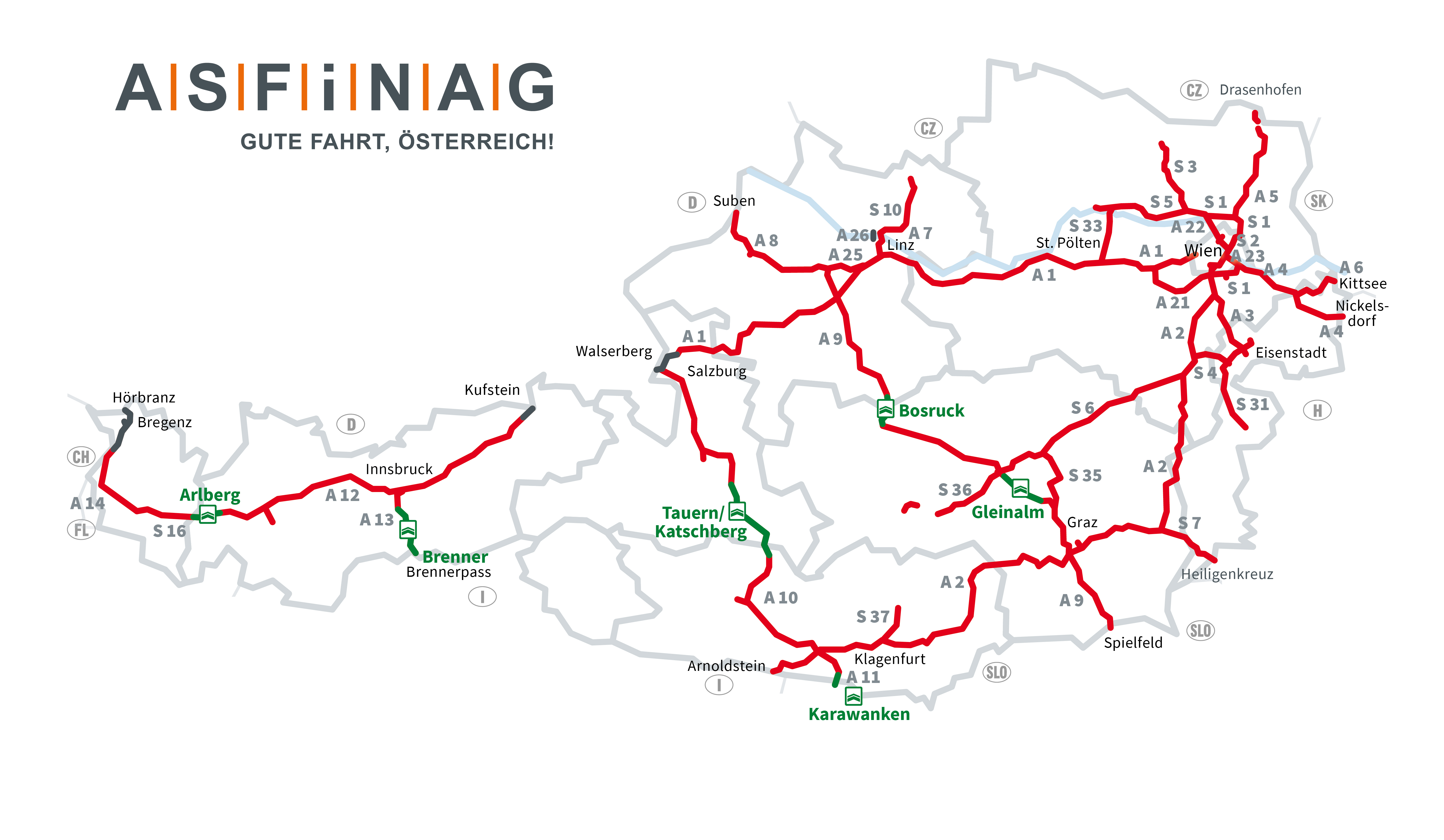
You pay the GO toll on the entire toll network in Austria – on motorways, expressways and toll sections.
The section network is divided into many small toll sections. This way, you only pay GO toll for the section you actually drive on (distance-related toll).
The best way to find out how much a section costs is to look at the rates or to use the toll calculator or the toll calculator light.
What you need
You need a technically suitable on-board unit

The GO toll system works with microwave technology (DSRC – Dedicated Short Range Communication). To be able to pay GO tolls, you need an on-board unit (OBU – on-board unit) that is suitable for this technology. You can obtain such a device from our GO points of sale: the GO-Box.
Also possible: Use the Toll Collect OBU or an EETS on-board unit.
How is the toll calculated?
Rate-relevant characteristics
The amount of the toll for vehicles with a maximum technically permissible laden mass over 3.5 t is calculated per kilometre driven (on the A 13 Brenner motorway it also depends on the time of day).
The following tariff-relevant vehicle characteristics additionally determine the amount of the toll:
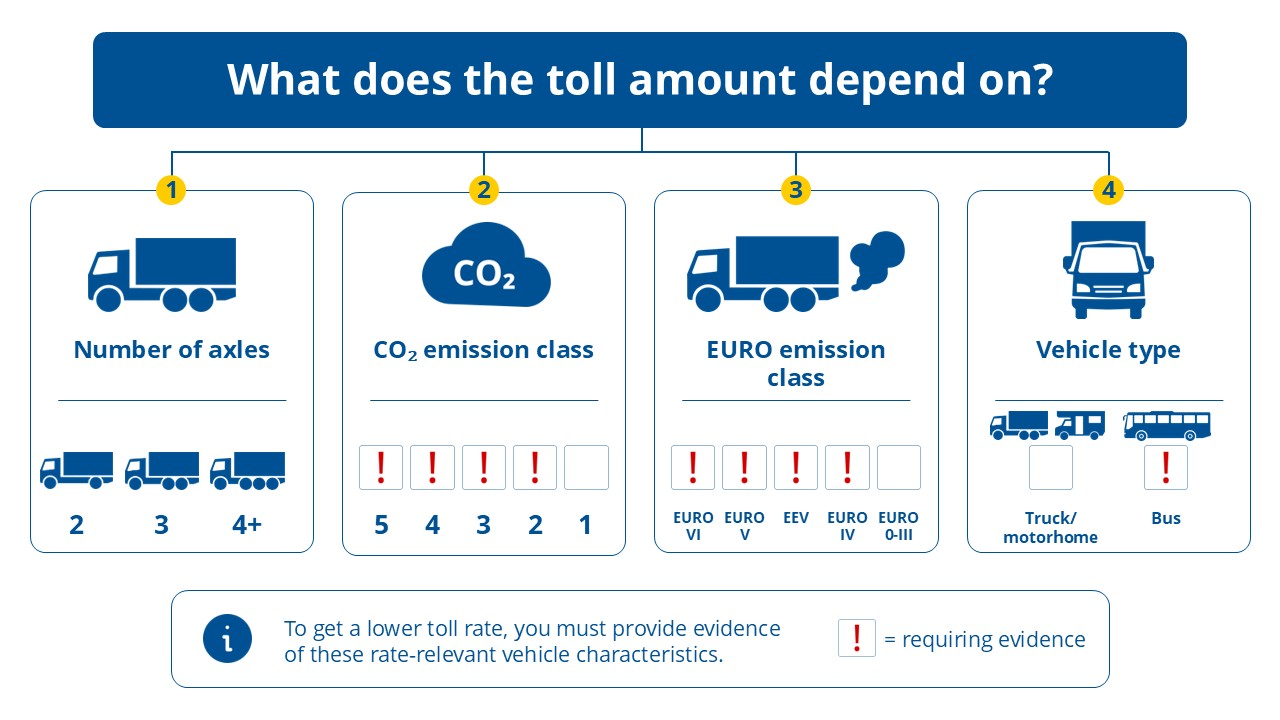
Rate characteristics requiring evidence
If your vehicle meets one or more of these characteristics, you can benefit from a lower rate:
- CO₂ emission class 5, 4, 3, 2
- EURO emission class EURO VI, EURO V, EEV, EURO IV
- Vehicle type: bus
To do so, you must provide evidence of these characteristics by the deadline. Without evidence, the vehicle will be assigned to the highest (most expensive) rate.
- Number of axles
Vehicles with a higher number of axles incur higher toll costs. - CO₂ emission class
The lower the CO₂ emissions, the lower the toll. Vehicles with a better CO₂ emission class pay less toll – CO₂ emission class 5 is the best and CO₂ emission class 1 is the worst. - EURO emission class
Newer vehicles with better exhaust emission values pay less. EURO VI is the best and EURO 0 - III the worst. - Vehicle type
Different rates apply depending on the vehicle type – HGV/motorhome or bus.
Obligation to provide evidence
Rate characteristics for which evidence is required
Pay particular attention to the fact that you must provide us with evidence of certain rate-relevant characteristics. You have 30 days to do this after registering for the GO toll system or after changing rate-relevant characteristics.
You can find all information on rate characteristics that require evidence here.
Obligation to cooperate
Find out in good time before your journey about the toll obligation in Austria and about the handling and function of the GO-Box.
The toll applies as soon as you enter the toll road network! There are signs at the access roads indicating that tolls are compulsory.
Please note the following points (see Tolling Regulations duties of motor vehicle drivers):
Obligation to cooperate
- Equip your vehicle over 3.5 t with a toll‑approved on‑board unit before using the toll road network (GO‑Box, Toll Collect OBU, EETS OBU).
- Check the vehicle declaration and carry it during your journey. Do the licence plate, EURO emission class, CO₂ emission class and type of vehicle match? Always keep data up to date!
- Mount the GO‑Box properly.
- Operate the GO‑Box properly.
- Check the functionality of the GO‑Box before, during and after the journey.
- Store the base category (minimum number of axles of the vehicle) and set the number of axles correctly on the GO‑Box.
- Observe the acoustic signals.
- Register a valid means of payment for the post‑pay procedure or ensure sufficient toll credit in the pre‑pay procedure.
- Replace the GO‑Box in good time before the expiry of validity.
- If necessary, pay the toll retroactively properly.
The cooperation obligations of vehicle drivers using other on-board units are the same as for the GO-Box. The installation and verification of the operational functionality of the on-board unit are carried out in accordance with the provider’s specifications.