


Paying the GO toll
How is the toll calculated?
Rate-relevant characteristics
The amount of the toll for vehicles with a maximum technically permissible laden mass over 3.5 t is calculated per kilometre driven (on the A 13 Brenner motorway it also depends on the time of day).
The following tariff-relevant vehicle characteristics additionally determine the amount of the toll:
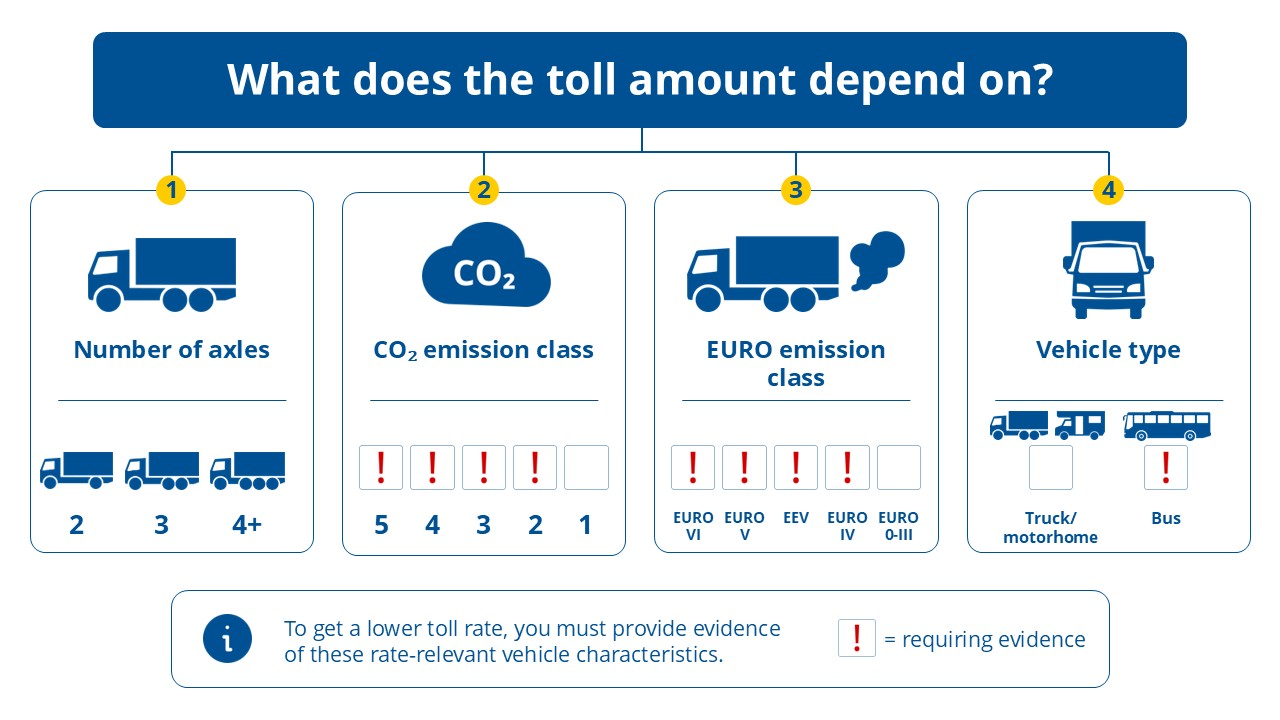
Rate characteristics requiring evidence
If your vehicle meets one or more of these characteristics, you can benefit from a lower rate:
- CO₂ emission class 5, 4, 3, 2
- EURO emission class EURO VI, EURO V, EEV, EURO IV
- Vehicle type: bus
To do so, you must provide evidence of these characteristics by the deadline. Without evidence, the vehicle will be assigned to the highest (most expensive) rate.
- Number of axles
Vehicles with a higher number of axles incur higher toll costs. - CO₂ emission class
The lower the CO₂ emissions, the lower the toll. Vehicles with a better CO₂ emission class pay less toll – CO₂ emission class 5 is the best and CO₂ emission class 1 is the worst. - EURO emission class
Newer vehicles with better exhaust emission values pay less. EURO VI is the best and EURO 0 - III the worst. - Vehicle type
Different rates apply depending on the vehicle type – HGV/motorhome or bus.
Tips for paying the GO toll
Calculate toll, means of payment, pay toll retroactively
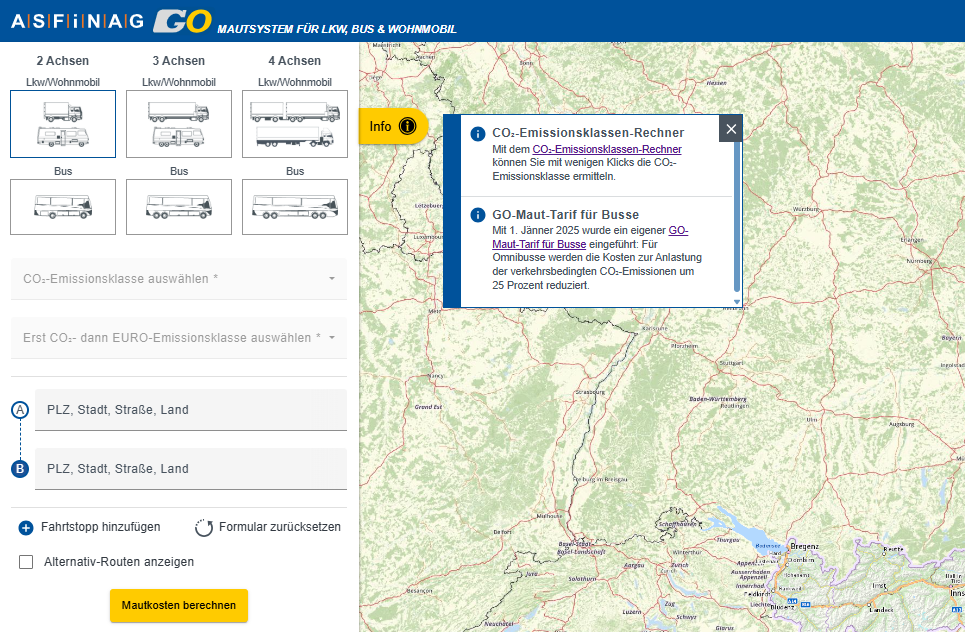
Calculate GO toll
Determine the toll amount prior to the journey with the toll calculator or the toll calculator light.
Please note: The calculated toll amount is only an approximate value without guarantee. The actual amount of the toll may differ.

Means of payment
Information on which payment methods are permitted for the Post‑Pay procedure (settlement afterwards) and for the Pre‑Pay procedure (debit via a previously purchased toll credit) is contained in Annex 2 of the Toll Regulation.

Pay GO toll retroactively
If you have not paid the toll correctly, you will have to pay the toll retroactively. This is possible under certain conditions.